Sunday, January 13, 2013

Briefly Knocked Unconscious by a Low-Flying Duck: Stories from 2nd Story


Review based on ARC.

Unfortunately for me, the title story was the first story, and I didn't like it.  I imagine if you liked that story, then the whole book is set up for you.  But for me, it was kind of going nowhere, kind of depressing, kind of just blah.  I've heard so many of that story, from so many perspectives, and this one fell flat for me.  I say unfortunately because it made me avoid reading (altogether) for a while, because I didn't want more of "that."

When I finally DID pick the book back up and bear down to geterdone, I was very pleasantly surprised.  No, I did not love all the stories - I felt that some were self-gratifying.. "look how RAW I am" kind of tone.  But on the whole, there was a lot of good stories, a lot of good telling, and some pretty good writing.

I particularly liked Push Kick Coast because it accomplished the "raw," harsh reality, without being so self-aware.  It was just.  So.  Well. Done.  Loved it.

And Why I Hate Strawberries... Well, I hated the story because of why she hates strawberries, but it was well told and I appreciated her courage.

Overall, I was pleased with the opportunity, but it felt a bit weighty to be put all together like that... I know that not all of the stories were sad, but they were all dark, weighty, lessoned.

I also enjoyed being brought back to Chicago -- having lived there for about a decade, the stories brought me back to my first adult home, and I enjoyed the nostalgia.

Overall, 3 1/2 stars because some were just excellent, some were okay, and a couple were really blasé.

Follows is a reaction-blurb of each individual story:

  • Briefly Knocked Unconscious by a Low-Flying Duck, by Matt Miller:  As I already stated, I did not love this one.  This was a cute title, a great hook, a well-phrased description of something that happened, and a boring story surrounding it all.
  • When the Fairies Came by Julie Ganey:  This one probably won't appeal to everyone, but it was a light (and welcome) moment of frivolity.  I really enjoyed it.
  • Push Kick Coast by Ric Walker:  Like I said above, this was the pinnacle.  So impressed with the way the whole story came together, the point, the awareness.  So impressed.
  • Crazy for You by Lott Hill:  I don't know.  Again, I kind of felt like, yeah yeah, I've heard it before.  It was cute and sweet, but kind of cliched.  I'm sure it was not cliched to the person experiencing it, but not all versions of the same story need to be told... 
  • This Teacher Talks Too Fast by Megan Stielstra:  This was pretty good, okay.  I knew where this story was going, but it almost seemed like the author felt like I was supposed to be surprised when it got there.  Nonetheless, I thought the ending was satisfying and redeeming.
  • Super K by Kim Morris:  This was one of the one's that mostly fell flat for me, but then I loved the ending, making me feel better about the whole story, overall.
  • Amber by Sam Weller:  I did not like Amber because I felt like I was just reading a Brag.  You know, your friend who once met [fill in name of celebrity] and just HAS to tell the story.  Like, Dude, I met this porn star, you know, the one from when I was a kid, and she totally wanted me. but I turned her down. I know, I'm awesome.  and you sit there smiling politely with your eyes glazing over.  It was like that.
  • A Cautionary Tale? by Eric Charles May:  This one was one of the lighter moments in the book... May told a potentially dark tale in a pretty light-hearted and certainly humorous fashion. I really enjoyed this one.
  • Why I Hate Strawberries by Deb R. Lewis:  As I stated above, I did not like the story, but because of what HAPPENS in the story, not because of how it was told.  I commend Lewis for telling her story - I am certain that this helps various audience members (and now, readers) come to different terms with their own stories.  
  • Foundationalysis by Lawrence Kerns:  This was okay.  It didn't really go anywhere, up or down.  I imagine it's a welcome break from the heartbreak, but it was just kind of blasé.
  • Xena: Cardboard Princess by Sara Kerastes:  I really enjoyed this.  It was cute and fun, serious and heavy.  It was well-told and ended just right.
  • The Kids and the King by Khanisha Foster:  This was another one of the stand-out pieces.  Although I felt like the author was a little self-gratifying, I really enjoyed her story, and I *REALLY* appreciated the resolution and what you learn from it.
  • Hollyweird by JC Aevaliotis:  I think that I enjoyed this one for a similar reason that many will -- it gives you some confirmation of that odd feeling you get when you think about Scientology!  But not only that, he told it well.  He had just the right amount of creep, suspense, and humor.  Another one of the stand-out pieces.
  • Dirty Dancing by Byron Flitsch:  This one was well-told and made me sad.  Not deeply sad (or angered) like Strawberries, but sad at the cruelty in the world, and at the loss of innocence (even if it's just the next degree of innocence).  Fortunately, Flitsch has a sense of humor about what he learned that night, and tells his story well employing that humor.
  • Running on Empty by Julia Borcherts: This was yet another stand-out piece.  I loved it, it was so well-told and well-paced.  It was believable, honest (had an honest tone), and whole.  I don't even really know what I mean by that word -- It just felt "complete" reading that one.
  • Tribes by CP Chang:  This was a pretty cute story, with some light moments, and just the right amount of unknown at the end.
  • Here, Capture Something by Andrew Reilly:  This is the perfect story for the romantics out there.  It was sweet, young, and innocent.
  • Covergirl by Kimberlee Soo:  I really liked this nostalgic little piece.  It was just the right tone to perfectly describe what it feels to be at that age.  What it feels to have an older sister.  What it feels to be different from everyone else, and to have someone notice how it's a benefit.
  • Foreigner in a Straight Land by J. Adams Oak:  This one is funny to start and light throughout.  Another sort of coming of age/coming out story, but innocuous and fine.  A little meh, but fine.
  • Here Comes Trouble by Randall Albers:  I liked it.  I liked what he did and how he did it.  I liked the realization of what it means to grow up and be responsible.  I like the transition, and I like the struggle against it.  It felt a little like sour grapes, but just a little, and, regardless, did not detract from the story.
  • A Prostitue Comparison by Molly Each:  I must have liked this one more than I realized because when I re-read the title to myself just now, a smile came to my face.  It was funny.  It was disgusting, but just in the right way, and just for the right reason.
  • Counting Days by Bobby Biedrzycki:  Loved this one.  Not because it was so poignant or moving -- I didn't know that it really was.  But because it was brave and honest.  Because Biedrzycki struggled and moved forward.  There was truth in the story, and hope.
  • Return Trip by Patricia Ann McNair:  This is another one of the stories that kind of went nowhere; yet, this one didn't really bother me -- so I assume it was because it was a well-told, well-written story.  I suppose I can see why they ended with this piece... it was an ending and a beginning in and of itself.

Tuesday, November 13, 2012

Being Santa Claus by Sal Lizard


Review based on ARC.

There's a lot of magic in a book like this.  It was encouraging and hopeful reading about all the ways in which the spirit of Christmas is alive and well.  I personally agreed with a lot of Mr. Lizard's points and perspectives.

Sal Lizard is a "Genuine Santa" and has spent the past two decades reminding people, young and old, that the spirit of Christmas is what matters.  The book really is a "feel good" book, and I spent many pages smiling, reminiscing, and, yes, wiping away tears.

The book does a nice job of going through the life of this genuine santa and many of his experiences, painting a complete picture of why his persona is more "genuine" than the rest.

What I didn't love about the book was really just that at times it seemed that the focus was more on Sal's good-deeds.  BUT, to be fair, the book was not actually written by Sal.  Sal told his stories, and the form they took in final publication may have been someone else's doing.

Indeed, Sal did do a lot of good in the world.  I didn't necessarily agree with all of his lessons or goals, but I didn't have to, to enjoy the book, the stories, the people, and the spirit of Christmas.  I particularly loved the story of Donna and have often hoped that I can someday make a similar, faceless impact on someone else's life.

Overall, a great "feel good" book for the holidays.
Definitely recommend!
FOUR of five stars.

Tuesday, November 6, 2012

Breathe by Sarah Crossan

On this, here, Election Day... a book review.  Nothing about the election ;)

Breathe is yet another dystopian, not-too-distant future, young adult novel about the dangers of taking something essential for granted, and, of course, some romance.  But don't get discouraged by that description.  When I first started reading the book, I sighed in resignation.

YET.  It was a great take on the "same-old."  In this instance, the essential element that we've taken for granted is, you guessed it, air.  We've cut down all the trees, and now we must subsist on manufactured air in a bubble.  The bubble is, of course, tightly managed by the elite, and there is, of course, a resistance.

But the story was very well told, the characters were vivid and believable (plus flawed! but not too flawed ;)), and the plot moves along at the perfect pace.  I read the book quickly, and I was very satisfied when I turned the last page.

For its audience, this book is definitely a stand-out.  I highly recommend.
FOUR out of five stars.

Saturday, November 3, 2012

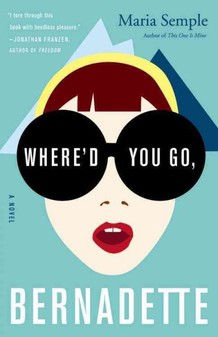
Where'd You Go, Bernadette by Maria Semple

First, I would like to link to my book group's Anne of Green Gables review, which is largely my review ;), posted here.

Ok, Bernadette...
This was also a book group book and, in fact, it was recommended to us by a non-book group member!  I am posting my separate review here because I expect that a lot of the Desert Girls will have a lot to say about this book, separate from my thoughts.

I really really really enjoyed this book.  I FLEW through the first half... as my bath got cold.  Bernadette is a sort of mixed media book, using letters, emails, transcripts, etc. to tell the story.  There is a little bit of narration by Bee (daughter) throughout the first 2/3 or so, and then quite a bit more narration in the latter portion.  The Desert Girls recently read Wife 22, which was also a mixed-media book, but Bernadette took the concept and, really, showed the world how it should be done.

The book is touted and/or implies that it is a mystery.  Bernadette has disappeared and we must discover where she went.  This is not a particularly accurate description.  Bernadette does disappear, but not until more than halfway through and then... well, you're not really unsure about where she went.  You don't know for certain, but you can piece it together pretty well.

Instead, the book is really a wonderfully told story about a rather dysfunctional family (aren't they all), with a mother (Bernadette) who is a genius hermit former architect, the daughter (Bee) who is a brilliant young girl with a medical history and a love of life, and the father (Elgie) who is a workaholic genius microsoft project head who loves his family, if from a distance.  Blech, sounds boring the way I just did that.  Trust me, it's not.

The characters are quirky, crazy, relatable, totally un-relatable, enraging, off-putting, loving, spiteful, and the complete heart of the story.  Semple does not describe her characters in the traditional sense; rather, she provides enough information to give you an outline, and a bevy of personality traits for the reader to fill in the details.  The story is less the point, focusing instead on the development of the characters and their character.

I thoroughly enjoyed reading Bernadette, and I highly recommend.  What made the book not perfect was the ending, which sort of dropped, just a little, in its intrigue.  The resolution was just a little less climactic than I would have hoped.  But it did not detract from the book as a whole, and it did not leave me feeling frustrated... just a little less than perfectly satisfied.

Highly recommend.
FOUR AND A HALF of five stars.

Tuesday, October 9, 2012

Tales from Lovecraft Middle School #1: Professor Gargoyle by Charles Gilman

Review based on ARC.

This book is listed for ages 9+ .. it's not far off.  This book is perfect for kids in the 8-12 age range.  It is a fun, fast-paced, entertaining read.  Robert Arthur has been transferred to the brand new Lovecraft Middle School, where he knows no one and has no friends.  Unfortunately, there is just one other student from his old middle school - the bully who appears intent on continuing the tradition at a new school.  Robert meets a quick friend in a girl who sympathizes with him after a bullying episode, but it takes him some time to finesse the relationship after Robert initially pushes her away in embarrassment.

Robert quickly learns that things at Lovecraft are not always as they appear.  By the end of the book, without presenting any spoilers, Robert has discovered the secret of the school, has found 3 (or perhaps 4) best friends, and is ready for the year ahead of him, whatever that year may bring.

The plot is simple and the characters are engaging.  The more sinister aspects of the book are not too dark and not too scary.  There's just a touch of it all, which is perfect for the 3rd to 7th grader who loves Halloween.

As a side note - the "lenticular cover" (it changes images) is beautifully done.  My husband said to me the other day, "I really like Professor Gargoyle!"  Based solely on that cover ;)

FOUR and a HALF of five stars.

Tuesday, September 25, 2012

Shadow Show by Sam Weller and Mort Castle (Editors)


Review based on ARC.

It is difficult to rate something written in honor of the eminent Mr. Bradbury.  Part of the rating must assuredly originate from the topic.  Part of the rating is in the appealability thereof.  And part must be from the writing and/or stories themselves.

In Shadow Show, many authors who themselves are worthy of celebration, gather to honor the works, life, and influence of Ray Bradbury.  I have only actually read two Bradbury novels, though 'the rest' have been on my wish-list for as long as I can remember.  Shadow Show renewed my desire to jump to it and start gathering the Bradbury tomes for my reading pleasure and intellectual enlightenment (according to those featured in Shadow Show ;)).

Some of the novels take a theme in a Bradbury piece and run with it; some are merely written in his honor; still others written in what the author hopes is his style.  All of the stories are followed by quick blurbs from the author explaining the impact Bradbury had on them in their lives and/or careers.

I enjoyed the collection as a whole, and, as stated above, I am eager to grace myself with other Bradbury pieces.  There were some stories that I loved, some that I liked, and just a couple that I felt were "meh."  (For those interested in a story-by-story blurb, see below.)  Overall, I highly recommend the collection.  Obviously, Bradbury fans will want to partake, but I equally recommend the collection to all readers -- people who love discovering new stories, new worlds.

Overall, FOUR of five stars.

The stories, individually blurb'ed, without acknowledgment of their added explanation/blurb.  The following is not a description OF the story (since they're so short) so much as a brief response TO the story.  I've noted after each whether they fit into a sort of fantasy/sci-fi category or a more "real-life" (drama) category:

A Second Homecoming by Ray Bradbury
This is more of a second introduction than a story.

The Man Who Forgot Ray Bradbury by Neil Gaiman (drama)
Neil Gaiman is one of my favorite authors, so I was actually a little disappointed with this one, the one I was probably looking forward to the most in the collection.  It was good, insightful, well written... but just didn't jump out at me and didn't do much other than pay homage.

Headlife by Margaret Atwood (sci-fi)
I particularly liked this one.  I've read one other Atwood (so far) and this one easily trumped it. As with the Handmaid's Tale, Headlife made a point about society, but does not shove your face in it.  This story was was also reminiscent of Twilight Zone and, dare I say, Futurama....

Heavy by Jay Bonansinga (drama)
Heavy was thought provoking and emotion-making.  It was simultaneously touching and grim; hopeful and morose.  Bonansinga did an excellent job of channeling what I think of as the Bradbury-spirit.

The Girl in the Funeral Parlor by Sam Weller (drama)
This one was a little creepy and had a wonderful concept.  I'd actually like to see this one developed into at least a novella and maybe put at least a little more into the sci-fi (or fantasy) category.  Regardless, I enjoyed reading this short and am looking into Weller a little more...

The Companions by David Morrell (sci-fi (fantasy))
I loved the way this one started and middle'd.  I did not love where the author went with it, but I understand it.  I imagine that this short will appeal to a lot of people, but for me, I wanted something more "fireworky" at the end.  The short felt, perhaps, a little self-indulgent.

The Exchange by Thomas F. Monteleone (drama)
This was another one that was okay and felt a little self-indulgent. It was a little sentimental in the way that it feels like you're listening to a story by a grandfather type, about that "one important person" who really impacted his whole life....  It was fine, but not spectacular.  Enjoyable but not staying (I had to re-read a little bit to remember which one it was just now...)

Cat on a Bad Couch by Lee Martin (drama)
I really loved this one and, whenever I think about "Shadow Show" as a whole, this is the story that first comes to mind.  It was so nicely put together, very complete, and impressive in its subtlety.  Martin's character is somehow relatable and even endearing in his weaknesses and very human desires.

By the Silver Water of Lake Champlain by Joe Hill (drama'ish)
Another great short.  Hill leads the reader around corners effortlessly, never hinting at what is on the other side of that corner.  His characterization is impressive given his subjects and, in the end, satisfies the reader while leaving her (me) longing...

Little America by Dan Chaon (sci-fi (fantasy))
He never comes right out and says it (and neither will I), but Chaon dances around his story - a theme that has become much more popular in the past couple decades - with a lithe leap.  The perspective is impressive, the plot is brief and to the point, and the end is, again, satisfying, and I appreciated that Chaon did not attempt to think for his reader.

The Phone Call by John McNally (sci-fi)
This one is right up my alley.  When I realized who the author was, I was not surprised and was, instead, reinvigorated in my desire to read more McNally.  His topic is not new anymore (though, as he states in his after-the-story blurb, he's been toying with the idea for a couple decades), but it is presented with a fresh spin, a modern perspective, and a thoughtful end.

Young Pilgrims by Joe Meno (sci-fi)
Another excellent story.  Exploring the next frontier in the context of a zealous religious group could, in another's hands, be inaccessible.  But Meno approaches both with an eye toward present, modern, and very-Earth concerns and ideas.

Children of the Bedtime Machine by Robert McCammon (sci-fi)
The story begins bleak and hopeless and slowly, subtly, moves into hopeful and bright.  I loved the concept, and I thought the characterization was really excellent.  I did, however, think the end was just a little too neatly packaged.  I like my happy endings, but with short stories such as these, leaving room for a little wonder is welcomed

The Page by Ramsey Campbell (drama'ish)
I really liked the way Campbell weaved just a touch of the possibility of supernatural into the everyday, the potentially mundane.  The story was informative and complete, yet still left room for the reader to question everything in the short -- the presence of perhaps a ghost and the influence of such an existence on everyday life.

Light by Mort Castle (drama)
I've read other Norma Jean / Marilyn Monroe pieces, but this one was really well done.  It was insightful and aware.  I don't know if any of the experiences and thoughts described therein were documented and merely re-played here in an effective manner or if Castle created it all from his, apparently vast, imagination.  The short was a believable account, deftly, efficiently, and emotionally told.

Conjure by Alice Hoffman (drama'ish)
I went out and bought another Hoffman this weekend as a result of this story.  I love exactly how she told it.  Nothing more needs to be said.

Max by John Maclay (sci-fi (fantasy)'ish)
I liked it, but I didn't love it. It was just a little too much like reading history for my tastes... a little too memoir and not enough story.  But, fine.

Two of a Kind by Jacquelyn Mitchard (sci-fi (fantasy))
This was probably my least favorite.  It was good, well-written, well-told.  It had a little bit of spook and a little bit of creep.  But in the end, it felt more like someone was trying to educate me than spin me a tale of two boys...

Fat Man and Little Boy by Gary A. Braunbeck (sci-fi'ish)
Another one I loved.  Braunbeck touches just enough on human frailty and conceit, the ego and insecurity.  He dabbles with the future and establishes a life.  I am interested in more of what he has to say...

The Tattoo by Bonnie Jo Campbell (sci-fi (fantasy))
I have, for some reason, mixed feelings about this one.  It is right up my alley, but I was, nevertheless, dissatisfied.  I love the concept, and I think that Campbell did a great job of describing the details.  I think that what was dissatisfying for me was the relationship side -- perhaps realistic, but unmoving.  Intriguing, but I feel like the story could have gone just a little bit further.

Backward in Seville by Audrey Niffenegger (sci-fi)
For those who know me, you know that I am the anti-fan when it comes to Niffenegger's Time Traveler's Wife.  Nonetheless, I purchased her second book, and I read this short with an open mind.  I felt, after reading Time Traveler's Wife, that Niffenegger has potential that could have been better illuminated by a more aggressive editor (vis-a-vis cutting about 150 pages from the 500-page book).  But I digress....  Backward in Seville was nice.  It was sentimental, which was not even slightly surprising.  Overall, I felt that with this (much) shorter foray, Niffenegger did a (much) better job telling her tale.  It was good.  Possibly even very good...

Earth (A Gift Shop) by Charles Yu (sci-fi)
I have heard of Yu and was eager to read this short.  Yu presents the tone just right. I mean, just right.  It is completely convincing in what it endeavors to accomplish.  You are reading (listening to audio of) a marketing brochure for Earth, a Gift Shop, written by (told by) a wry, self-defacing marketer.  Looking forward to more Yu.

Hayleigh's Dad by Julia Keller (sci-fi)
Awesome.  Am definitely going to look into more Keller.  Maybe it's this one.. maybe this is my favorite...

Who Knocks by Dave Eggers (sci-fi)
This is in the tone of an urban legend.  And it was fun.  Not deep, but fun.  And creepy.  Enjoyed my first tiny jaunt into Eggers-land.

Reservation 2020 by Bayo Ojijutu (sci-fi)
This was well told, but it felt a little preachy.  I understand that a lot of authors are moved by Bradbury's ability to preach so effortlessly, but that's the point -- it's effortless.  In Fahrenheit 451, the reader gains a sense of Bradbury's opinion, perspective, and, as far as he is concerned, truth.  But it's a story first.  Ojijutu's story has intrigue, and I loved (loved) the interaction between Joseph and the Governor, but overall, I felt that the tale fell flat -- onto a moral message and not a story.  It was not bad, and it was certainly well-written, it was just not my favorite.

Two Houses by Kelly Link (sci-fi)
Kind of awesome.  Reminds me of Haunted by Chuck Palahniuk for some reason.  Fun, light, deep, and provocative.  I'm curious about Link...

Weariness by Harlan Ellison (sci-fi)
His name is trademarked, which made me feel like I've missed out on a lot of good sci-fi.  I thought the story was OK, a nice thought, a well-done conclusion to "it all."  But what I really enjoyed from Ellison was actually his after-the-story blurb.  He sounds like just the sort of person I'd love to have a long conversation over tea with..

QED.

Monday, September 17, 2012

Whispers Under Ground by Ben Aaronovitch


This book was, apparently, the third in a series.  Having read it out of turn, the mystery stands on its own, but some of the side points were left unexplained -- the fact that the author did not re-explain every interesting point is something I definitely would have appreciated, had I read the first two books.  In this one, it left me wondering, but did not interrupt the story.

Semi-rookie Peter Grant investigates crimes in London when "other" explanations are required.  His partner Lesley wears a mask because, as she explains at the beginning of the book, her face fell off.  I imagine this whole story is encompassed in book 2, but in book 3, it merely adds to the overall ambience of the book.  Nightingale is their boss and they live at the Folly with Molly, who I assume is their ghost housekeeper (again, probably detailed in a prior book).

The mystery in this book is fun and Aaronovitch spends time going through the hoops of crime investigation.  It's an entertaining read for a saturday afternoon or a plane ride (where I did most of my reading).

On the cover is a portion of a review that claims that this book is the perfect mix of Harry Potter and CSI.  As a Harry Potter fan, I beg to differ.  This book is more like the Dresden Files, without the same level of darkness or angry wry humor, and with more investigation and cop-speak.  I can only assume the Harry Potter reference on the cover is due to a few Harry Potter references throughout the book itself, and the fact that there are wizards and "fae."  Perhaps if I had read books 1 and 2 I might understand the comparison more -- being brought through a new world and learning of magical creatures as the main character does is part of the magic of Harry Potter.  Harry Grant spends more effort not being shocked because cops are supposed to know  more than the public and, necessarily, an element of wonder is absent.

Overall, I enjoyed Aaronovitch's sense of humor (quite a lot at times), and I appreciated the distinctly london feel and dialect.  I would recommend the book, particularly to someone who is interested in a detective solving crimes involving the supernatural.